Choosing the right temporary EV Charger for your site
Temporary sites, such as construction sites, TV & film locations, music festivals & sporting events put different demands on EV charging than a typical home driveway or office car park. The right choice of charger affects not just convenience, but also health & safety, compliance and charger uptime. Below is a simple guide to the main AC EV charging options used on temporary sites, and why purpose-built temporary EV chargers are usually the best fit.
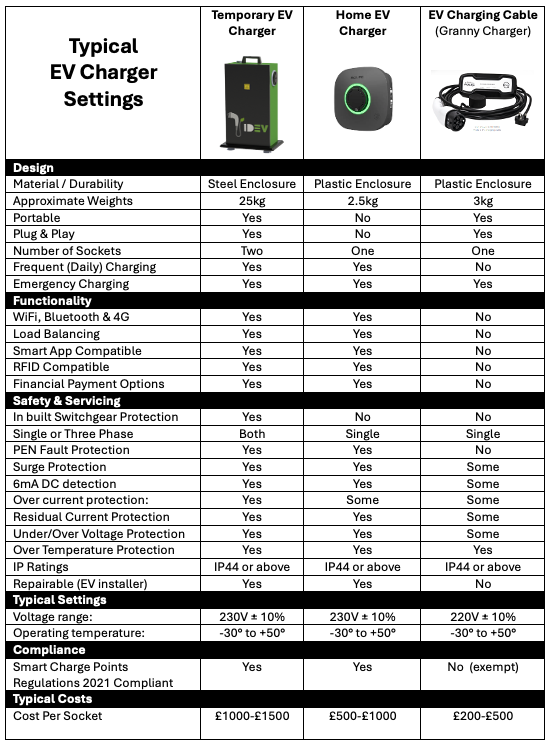
1. Purpose-built temporary EV chargers – our recommended solution
Temporary EV chargers are specifically engineered for challenging, mobile environments:
Health & Safety: Built with the correct protection (including PEN fault protection and suitable RCDs) and designed to be installed for connection to temporary power.
Robust: Steel, industrial enclosures and connectors that can handle transport, weather and busy compounds.
Easy to use: Clear sockets, sensible cable management and good accessibility for drivers.
Repair & testing: Designed to be inspected, tested and maintained in line with the Institution of Engineering and Technology (IET) Code of Practice for Electric Vehicle Charging Equipment Installation.
Speed: Typically, 7–22 kW, giving practical turnaround times for site vehicles and visitors.
For most temporary sites, these units provide the safest and most reliable solution.
2. Home chargers in crash frames – usable with care
Domestic EV charger wallboxes temporarily mounted can work on some smaller or lower-risk temporary sites:
They generally meet safety and legislative requirements, when correctly installed.
However, they are not designed for repeated transport and rough handling; plastic housings are more easily damaged.
Typically, single-outlet and slower to use on busy sites, with more limited options for placement and accessibility.
We see these as suitable where located in low risk areas and where movement is infrequent.
3. “Granny chargers” – occasional use only
Portable “granny” leads are intended for occasional or emergency charging, not daily use:
The IET advises that Mode 2 “granny” leads are not suitable as a regular, long-term charging solution and should only be used occasionally.
They typically do not include PEN fault protection, so a supply fault could make the vehicle body live.
Where connected to domestic sockets, wiring should be checked to ensure circuits are designed for sustained EV loads, to prevent the risk of overheating, damage or fire.
Outside current smart charging regulations and may lack key safety and control features.
On temporary sites, granny chargers should be treated as a last resort, not for primary charging.
Key points when specifying temporary EV charging
When you’re selecting equipment, check that your solution is:
Safe: Proper protection, installed and tested to the IET Code of Practice.
Robust: Built to survive transport, weather and site conditions.
Practical: Easy for drivers to find, use and access safely.
Maintainable: Simple to inspect, repair and re-deploy.
Fast enough: Delivers suitable charge rates for your vehicles.
If you’re unsure what’s appropriate for your site, IDE can help you design a temporary EV charging solution that balances safety, compliance and practicality.
Comparison of typical portable AC EV charger functionality